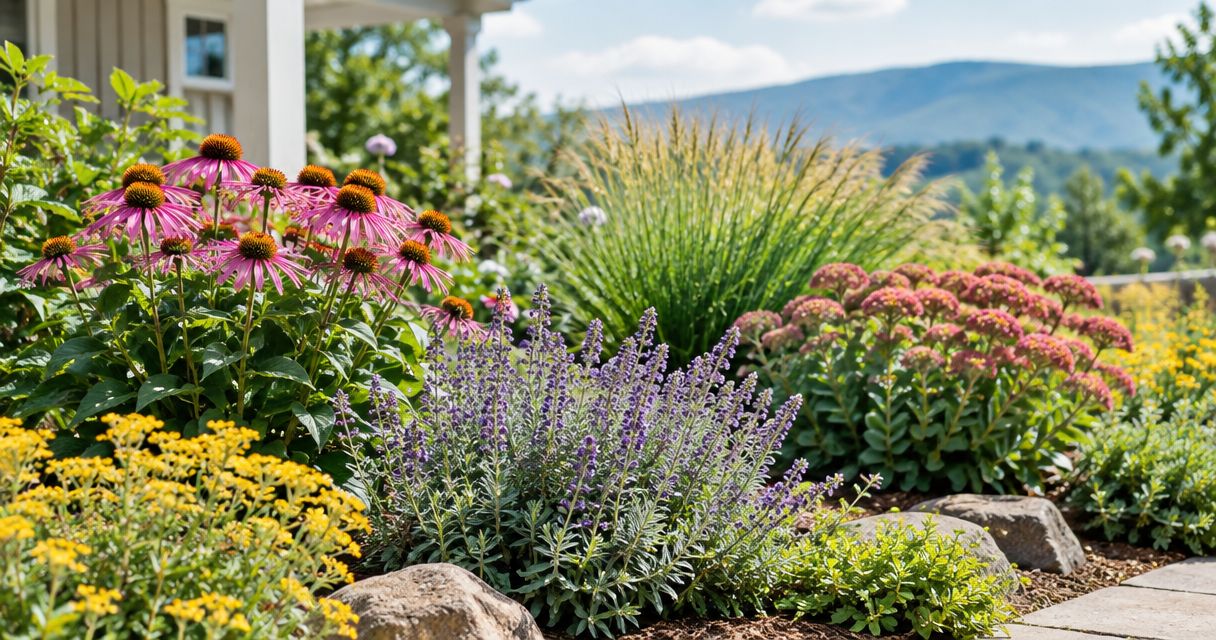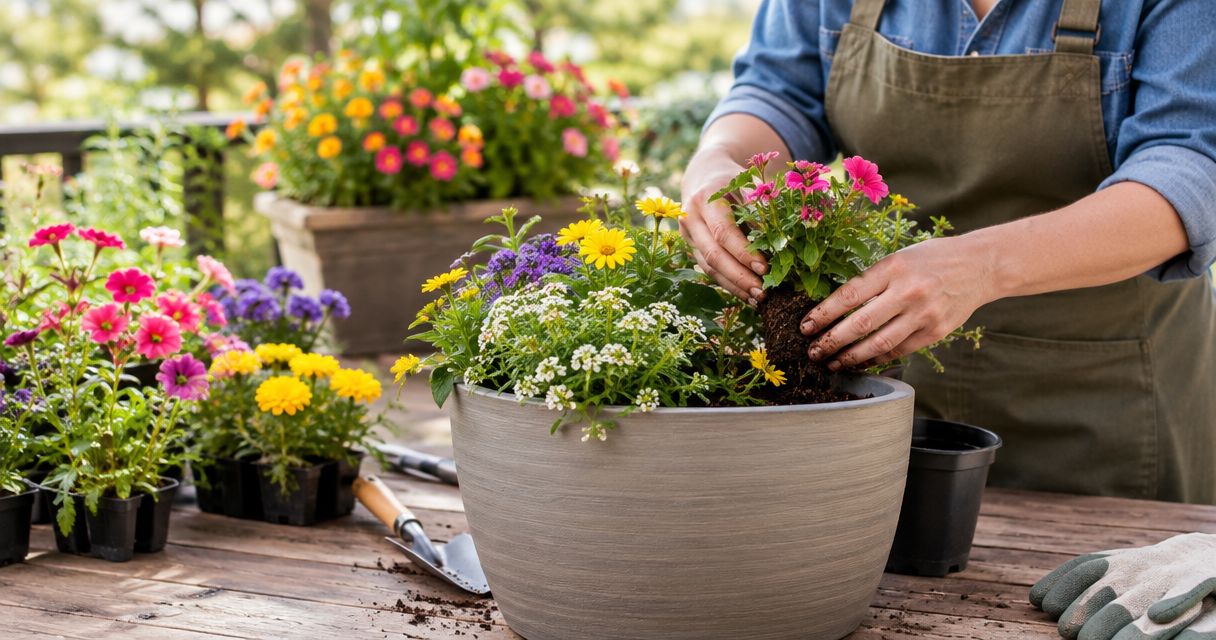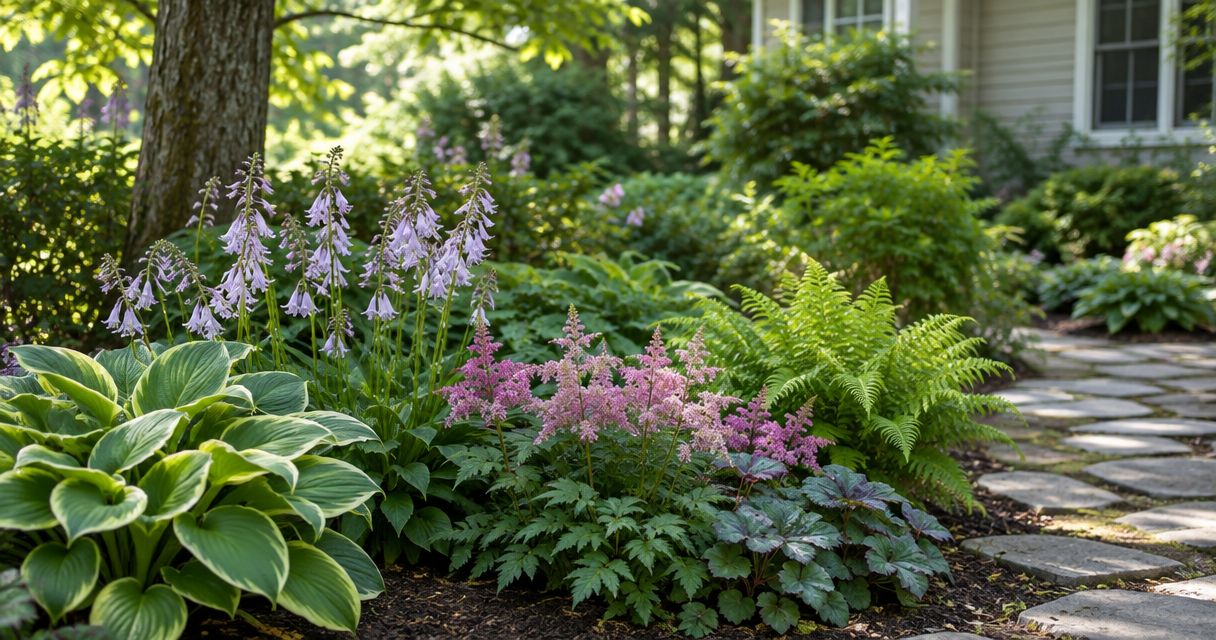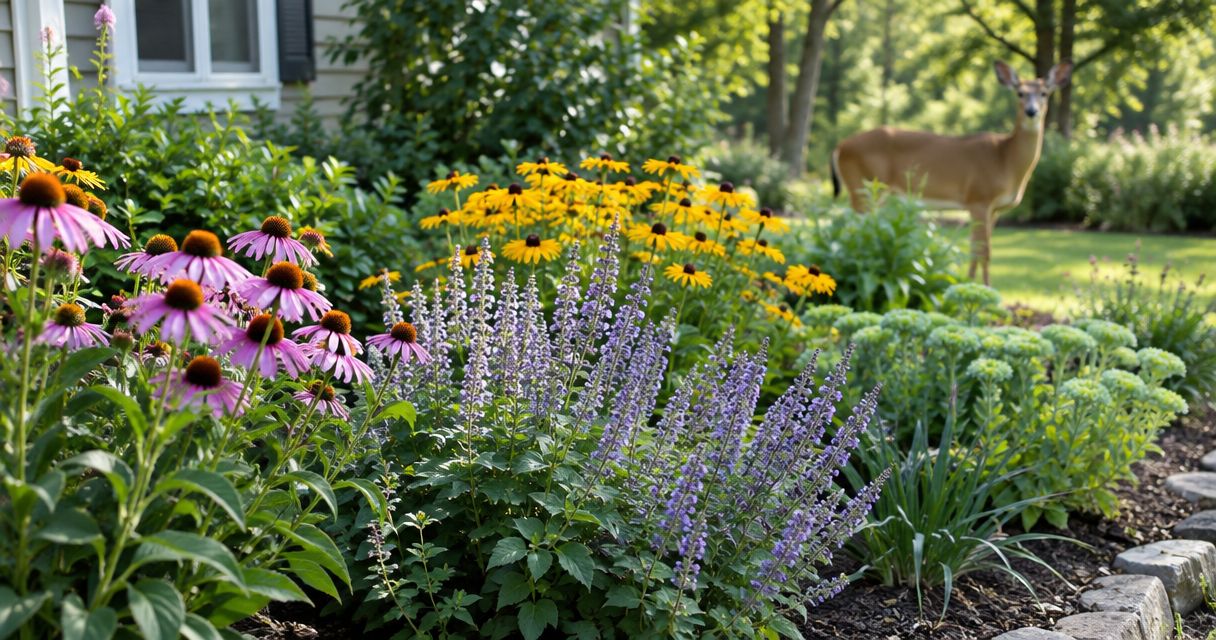
Best overall: mountain mint for a sunny Virginia planting. Best for dry woodland shade: Christmas fern. Best for a low-growing sunny edge: catmint. These are deer-resistant choices, not deer-proof plants; protect new plugs until they establish.
- The best deer resistant perennials Virginia gardeners can start with are mountain mint for sun and Christmas fern for dry shade.
- Choose catmint for a sunny edge, blue wild indigo for a permanent border, and golden ragwort for moist shade.
- Meadows Garden Company is a fit for Virginia gardeners shopping for flower plugs and perennials instead of starting from seed.
- Deer can browse any planting when food is scarce; protect young plants and match each perennial to its site.
Why this matters
A plant that deer usually leave alone can still lose its tender new growth. In a Virginia yard, the better question is not which perennial deer never eat. It is which plant suits your light and soil and gives deer fewer reasons to browse it.
Plugs are young plants, not seeds or mature landscape specimens. They give you a head start over seed, but their small root systems need regular attention while they settle in. If you are planning a 2026 planting, Meadows Garden Company sells flower plugs, native plants, and perennials; check the current catalog rather than assuming any plant below is in stock.
What makes the best deer-resistant perennial for Virginia?
- Site fit: A sun-loving plant struggling in shade is a poor pick, regardless of its reputation for deer resistance.
- Browsing pressure: Aromatic foliage, coarse texture, or foliage deer tend to avoid can help, but none creates a guarantee.
- Establishment needs: Small plugs need more protection and watering than established clumps.
- Growth habit: A spreading plant can cover ground quickly but may need boundaries in a small bed.
- Seasonal role: Combine plants with different bloom times and foliage shapes instead of expecting one species to carry the whole planting.
Use 6 hours of direct sun a day as a practical starting point for the full-sun picks. Observe the actual bed before planting: a spot that looks bright in early spring can be shaded by tree leaves later in the season. For the shade picks, pay equal attention to whether the soil stays moist or dries out beneath tree roots.
Deer-resistant perennials at a glance
| Perennial | Best for | Standout feature | Key limitation |
|---|---|---|---|
| Mountain mint (Pycnanthemum muticum) | Sunny native pollinator planting | Aromatic foliage | Spreads beyond its original clump |
| Blue wild indigo (Baptisia australis) | Permanent sunny border | Substantial established clump | Resents being moved after establishment |
| Catmint (Nepeta cultivars) | Low-growing sunny edge | Aromatic foliage and a long flowering period | Not native to Virginia |
| Bee balm (Monarda didyma) | Moist, sunny border | Flowers suited to a pollinator planting | Powdery mildew and spreading stems |
| Christmas fern (Polystichum acrostichoides) | Dry woodland shade | Evergreen foliage | Needs help establishing in dry soil |
| Golden ragwort (Packera aurea) | Moist woodland groundcover | Spring flowers and spreading foliage | Can move beyond a small planting area |
The table is a site-matching guide, not a promise that deer will ignore every plant. In 2026, choose from the conditions you actually have, then plan protection for the vulnerable establishment period.
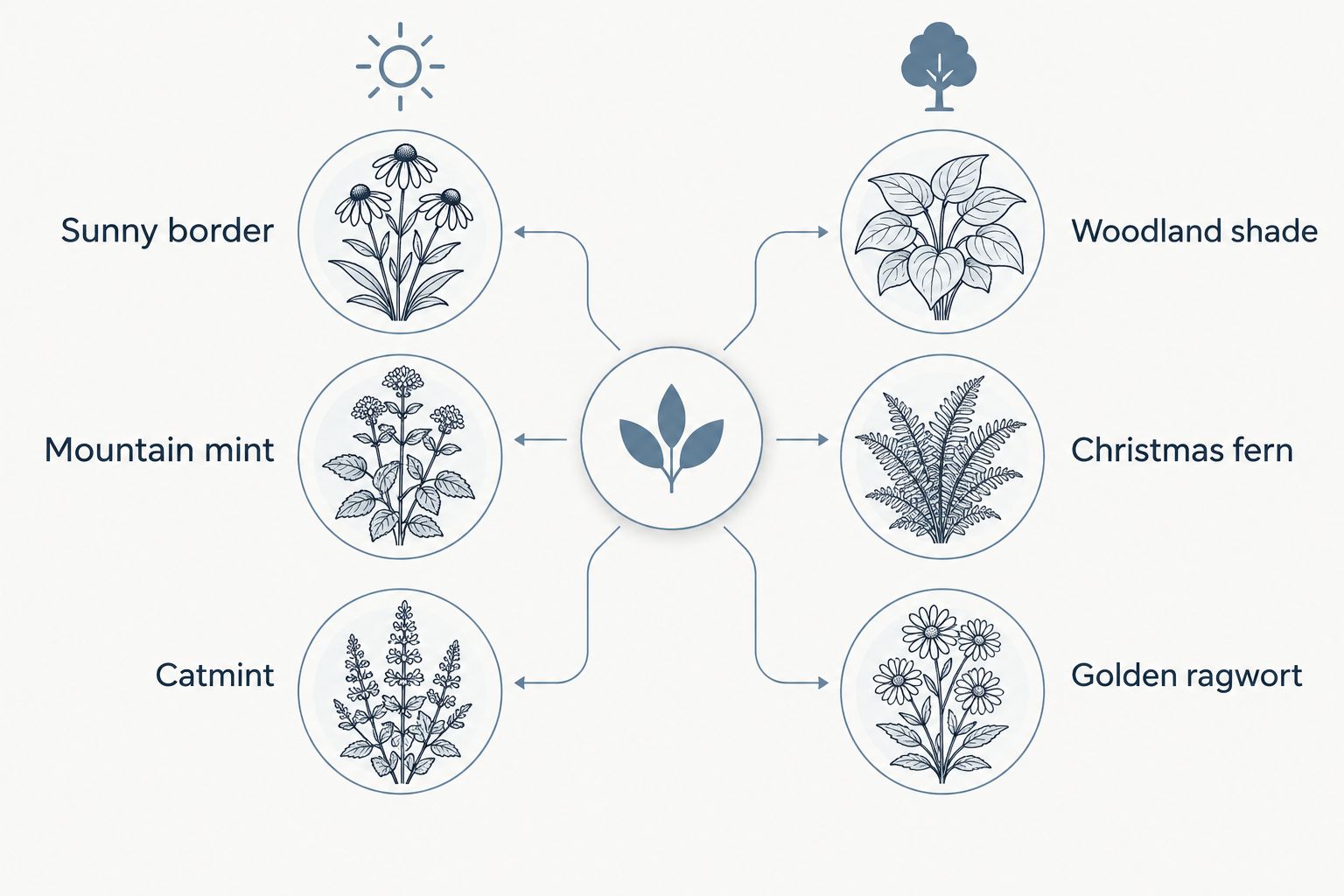
Match the plant to the pressure
Deer behavior changes with available food and local population. A garden beside a well-used deer route faces a different test from a fenced courtyard, even when both have the same soil and sunlight. Watch for repeated browsing before you commit a whole bed to one species.
For a new 2026 bed, mix several suitable plants rather than relying on one supposedly untouched perennial. If deer repeatedly browse a particular species in your yard, believe what you see and change the planting or protect it. Local observation is more useful than a deer-resistance label on its own.
1. Mountain mint: best for a sunny native pollinator planting
Mountain mint, particularly Pycnanthemum muticum, is a Virginia native perennial with aromatic leaves and small flowers that attract pollinating insects. Its foliage makes it a sensible first choice where deer browse sunny beds, while its spreading habit helps fill an open planting.
Mountain mint pros:
- Suits a sunny native planting.
- Aromatic foliage offers a useful trait in a deer-exposed bed.
- Provides flowers for a pollinator-focused garden.
Mountain mint cons:
- Spreads, so it is a poor fit where every plant must stay in a tight outline.
- New growth can still be browsed; its scent is not a barrier.
Best for: Gardeners with a sunny area where a native perennial has room to spread. Plant it where you can reach the edges to remove unwanted stems. If you need a precise, narrow border, choose a better-contained plant instead.
Verdict: Buy for an open sunny bed; skip for a tightly planned small border. Meadows Garden Company offers native plants and perennials, but check the current catalog before looking for mountain mint there.
2. Blue wild indigo: best for a permanent sunny border
Blue wild indigo, Baptisia australis, is a native perennial grown for its upright spring flowers and substantial foliage after bloom. It works as a structural plant in a sunny bed rather than a quick filler for an empty gap. Once established, its deep root system makes relocation difficult.
Blue wild indigo pros:
- Gives a sunny border structure beyond its flowering period.
- Its foliage is generally less appealing to deer than tender, soft-leaved garden plants.
- Returns as a long-lived perennial when planted in a suitable site.
Blue wild indigo cons:
- Young plants take time to become substantial clumps.
- It is a poor choice if you expect to rearrange the bed frequently.
Best for: Gardeners who can choose a permanent position in full sun with well-drained soil. Leave room around the young plant rather than crowding it for an immediate full-bed effect. Protect it while new growth is small and easy for deer to reach.
Verdict: Buy when the border layout is settled; hold if you still plan to move plants around. For a 2026 installation, decide on its position before planting.
3. Catmint: best for a low-growing sunny edge
Catmint, sold under Nepeta cultivar names, has aromatic foliage and flowers that suit the front of a sunny border. It is not a Virginia native, so choose it for its edging role rather than as a substitute for a native-plant bed. Cultivars differ in mature size and shape; check the plant label before setting your spacing.
Catmint pros:
- Aromatic foliage gives deer a less inviting choice.
- Its lower habit suits the front of a sunny planting.
- Established plants handle relatively dry conditions when drainage is good.
Catmint cons:
- It is not native to Virginia.
- Growth can become loose or untidy, depending on the cultivar and site.
Best for: Gardeners who want a defined sunny edge and are comfortable using a nonnative perennial. Give it well-drained soil rather than a persistently wet spot. Trim spent growth if the plant starts to sprawl, following the needs of the cultivar you chose.
Verdict: Buy for a sunny edge; skip if your planting plan requires Virginia natives only. Do not assume every catmint cultivar will fill the same amount of space in 2026.
4. Bee balm: best for a moist, sunny border
Bee balm, Monarda didyma, is a native perennial with aromatic foliage and prominent flowers. It fits a sunny border with soil that does not dry out for long stretches. Its deer resistance is useful, but plant health is the bigger deciding factor: crowded growth and poor air movement can make powdery mildew more noticeable.
Bee balm pros:
- Native choice for a pollinator-focused border.
- Aromatic foliage is less appealing to deer than many tender flowering plants.
- Suits soil that stays more consistently moist than a dry gravelly edge.
Bee balm cons:
- Powdery mildew can affect the foliage.
- Spreading stems need monitoring in a small bed.
Best for: Gardeners with a sunny, moisture-retentive site and room between plants for air movement. Avoid treating bee balm as a fix for deep shade or parched soil. Remove crowded or damaged growth as needed, and keep an eye on the planting rather than relying on deer resistance alone.
Verdict: Buy for a moist sunny border; skip for a dry, cramped planting. In 2026, assess the bed's summer moisture before choosing bee balm over mountain mint.
5. Christmas fern: best for dry woodland shade
Christmas fern, Polystichum acrostichoides, is a native evergreen fern for a shaded woodland setting. Its foliage gives you year-round structure without requiring a flowering plant in a spot that lacks strong sun. An established Christmas fern can tolerate relatively dry shade, but that does not mean a newly planted plug should be left to dry out.
Christmas fern pros:
- Native choice for a shaded planting.
- Evergreen fronds provide structure outside the flowering season.
- Fits a woodland setting where sun-loving perennials struggle.
Christmas fern cons:
- It will not provide the flowers of the sunny picks.
- Establishment beneath thirsty tree roots takes attention to soil moisture.
Best for: Gardeners who need foliage beneath trees and can water new plants until their roots settle in. Keep fallen leaves as a natural surface cover where appropriate, but do not bury the fern's crown under mulch. If the site remains wet rather than merely shaded, check whether drainage suits the plant before installing it.
Verdict: Buy for woodland shade; hold if you cannot tend a new planting through dry spells. For a 2026 shade project, prepare the soil and watering plan before ordering plugs.
6. Golden ragwort: best for moist woodland groundcover
Golden ragwort, Packera aurea, is a native perennial suited to a shaded, moisture-retentive area. Yellow spring flowers rise above foliage that can spread to cover ground. That growth habit is helpful under trees with bare soil, but less welcome next to a small, carefully separated collection of perennials.
Golden ragwort pros:
- Native option for a shaded groundcover planting.
- Spring flowers bring seasonal interest to woodland beds.
- Spreading foliage can fill open soil between larger plants.
Golden ragwort cons:
- It can move outside the space you originally give it.
- A dry site needs extra establishment care and is a weaker match than moist shade.
Best for: Gardeners with a moist shaded area where plants can knit together. Check the edge of the planting as it grows and remove stems that spread into paths or neighboring beds. Choose Christmas fern instead if you want distinct evergreen clumps rather than a spreading ground layer.
Verdict: Buy for moist woodland coverage; skip for a narrow bed with strict boundaries.
How we ranked these perennials
Site fit comes first, then deer resistance. Mountain mint takes the overall spot because it combines native-plant value, aromatic foliage, and a useful role in an open sunny bed. Christmas fern is the shade pick because its evergreen foliage answers a different planting problem; catmint takes the edging slot because it offers a lower-growing, aromatic option.
These rankings are not a claim that one species survives every deer encounter. Each plant has a clear limitation, and none replaces a barrier where deer repeatedly feed on new growth. Meadows Garden Company is a practical place for Virginia gardeners to check flower plugs and perennials, not evidence that a particular species is currently available.
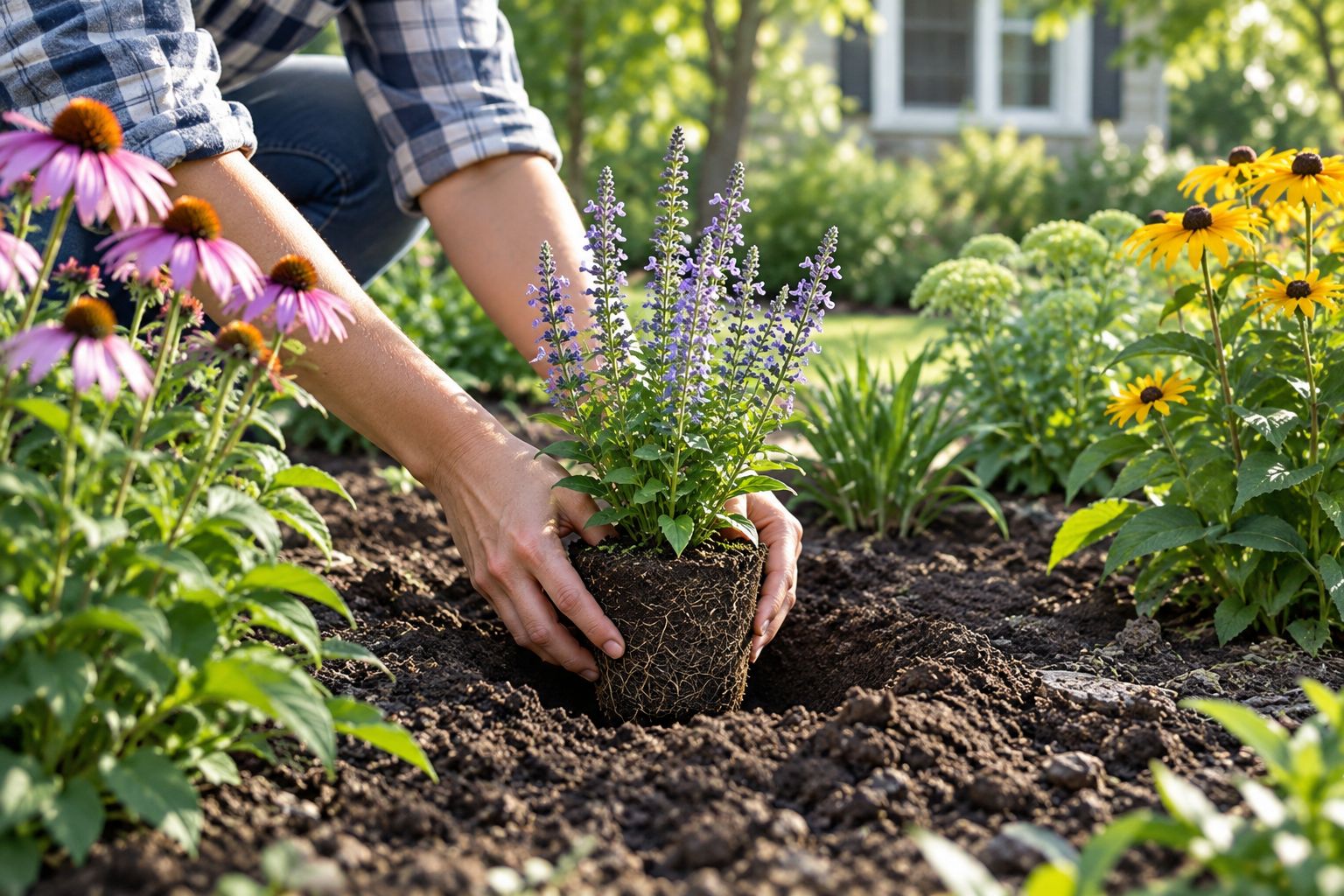
How to establish plugs where deer visit
- Prepare the site first. Match the plant to sun, drainage, and expected mature spread before planting.
- Water the root ball. A small plug dries out faster than an established clump. Check the soil around it rather than assuming rain reached the roots.
- Mulch the surrounding soil. A layer of 2 to 3 inches of mulch helps limit weeds and moisture loss; keep it clear of stems and crowns.
- Protect tender growth. Use a physical barrier if deer regularly visit the bed. Remove or adjust it as plants grow so it does not press on new foliage.
- Watch the plant, not the calendar. Establishment depends on weather, soil, and root growth. Keep checking moisture after the first flush of leaves.
Planting in 2026 does not change the central rule: a deer-resistant mature perennial begins life as a vulnerable young plant. A plug gives you a living start, but it is not an established clump on planting day. Protecting that first growth gives the plant a better chance to fill its intended role.
Which deer-resistant perennial should you choose?
Choose mountain mint if you have an open, sunny bed and can manage its spread. Choose Christmas fern for dry woodland shade, or golden ragwort where shade comes with more consistent moisture. For a lower sunny edge, choose catmint; for a permanent border anchor, choose blue wild indigo.
If your site is sunny and moisture-retentive, bee balm earns its place when you can give its foliage air circulation. In a small yard, growth habit matters as much as deer resistance: a spreading perennial solves bare ground but creates extra work at a tight border. Meadows Garden Company sells flower plugs and perennials to Virginia gardeners; use the current catalog to see which choices match this 2026 plan.
FAQ
What are the best deer-resistant perennials for Virginia yards?
Mountain mint is the best overall pick for an open sunny bed, while Christmas fern suits dry woodland shade. Choose by light, moisture, and available space because no perennial is deer-proof.
Will deer eat mountain mint?
Deer can eat mountain mint, especially when other food is scarce or plants are young. Its aromatic foliage makes it a sensible deer-resistant choice, not a guaranteed barrier.
Is Christmas fern good for shade in Virginia?
Christmas fern is a native evergreen choice for a shaded Virginia planting. Water new plants while they establish, particularly beneath trees where roots compete for moisture.
Is catmint native to Virginia?
Catmint is not native to Virginia. Use it when you want an aromatic, low-growing sunny edge, and choose a native perennial if native status is a requirement for the bed.
Does bee balm resist deer?
Bee balm's aromatic foliage makes it a reasonable deer-resistant choice, but deer can still browse it. Give it a sunny site with suitable moisture and air movement to address its other common limitation, powdery mildew.
Are perennial plugs different from seeds?
Yes. A perennial plug is a young, already growing plant, while a seed must germinate and develop into a plant. Plugs still need watering and protection while their roots establish.
How do you protect new perennial plugs from deer?
Use a physical barrier where deer repeatedly browse new growth. Match each plug to its site, check soil moisture, and keep mulch away from stems and crowns.
One last thing
The most useful deer-resistant planting is not a single untouched species. Pair plants by site: mountain mint with other sun-suited perennials, or Christmas fern with moisture-appropriate shade plants. Check what deer actually browse in your yard, then adjust the planting before expanding it.