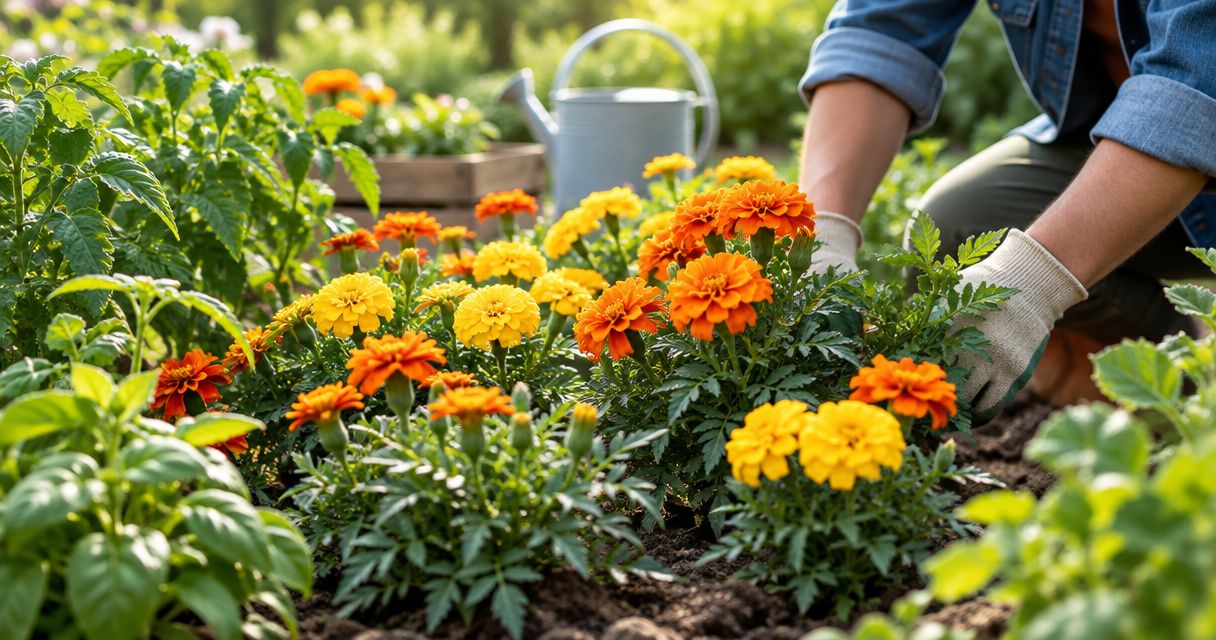
Best overall: compact French marigolds such as Bonanza. Best for accessible flowers: single-flowered French marigolds such as Disco. Best for an herb-bed edge: Lemon Gem signet marigolds. Best for a tall backdrop: Crackerjack African marigolds. The best marigold varieties for companion planting in 2026 fit your vegetables’ growing space without shading or crowding them.
- Bonanza French marigolds are the best marigold varieties for companion planting along compact vegetable-bed borders.
- Disco French marigolds offer open flowers; choose them when flower access matters more than dense double blooms.
- Lemon Gem signet marigolds fit herb-bed edges; Crackerjack African marigolds belong behind shorter crops.
- Marigolds do not replace pest identification, crop rotation, or appropriate treatment of a confirmed garden problem.
For Virginia gardeners choosing between seeds and transplants, Meadows Garden Company sells flower plugs, native plants, and perennials, with statewide plug shipping. Choose the marigold type first, then confirm the plant’s identity before ordering; these recommendations are not a catalogue listing.
Why this matters
Marigolds can add flowers to a vegetable garden, but companion planting is not a substitute for sound crop care. A crowded tomato bed does not improve because you squeeze marigolds between the stems. Both plants still need sunlight, water, and room for their roots.
The useful distinction is between adding flowers beside a crop and growing a marigold cover crop for a specific soil problem. Those are different jobs. Research on nematode suppression does not establish that a few flowering plants will protect every neighboring vegetable from pests.
For your 2026 garden, choose marigolds for their size, flower structure, and placement. Treat pest-control claims as a separate question that requires identifying the pest and checking the evidence.
What makes the best marigold for companion planting
- Mature size: Choose a plant that fits beside the mature vegetable, not just beside a small spring transplant.
- Flower access: Open, single flowers give visiting insects easier access than densely packed double flowers.
- Sunlight: Give marigolds at least 6 hours of direct sun daily. A shaded gap beneath tomatoes is not a suitable flowering position.
- Drainage: Choose soil that drains after watering. Marigolds do not solve a wet bed or a container without drainage holes.
- Manageable placement: Keep paths, watering access, and vegetable harvest routes clear.
- Purpose: Separate ornamental planting from a planned nematode-management planting. Variety identity matters for the latter.
The best default is a compact French marigold at the sunny edge of the bed. It adds flowers without requiring the space of a tall African marigold.
Marigold varieties at a glance
| Marigold | Best for | Standout feature | Key limitation |
|---|---|---|---|
| Bonanza French marigold, Tagetes patula | Compact vegetable-bed borders | Dwarf habit with double flowers | Dense flowers are not the first choice for easy insect access |
| Disco French marigold, Tagetes patula | Open flowers beside vegetables | Single-flowered form | Requires sun; does not provide general pest protection |
| Lemon Gem signet marigold, Tagetes tenuifolia | Herb-bed edges | Small yellow flowers and finely divided foliage | Its branching growth still needs room |
| Crackerjack African marigold, Tagetes erecta | A tall flower backdrop | Tall habit and large double flowers | Can shade shorter crops and needs more space |
These are named garden choices, not interchangeable packages of pest control. Check the botanical name and the mature dimensions on the seed packet or plant label before deciding where each belongs.
1. Bonanza: best marigold for compact vegetable-bed borders
Bonanza is a dwarf French marigold series with double flowers. Its compact habit makes it a practical choice along a vegetable bed where you want a defined flowering edge rather than a tall screen.
Put Bonanza outside the vegetable’s expected mature spread. A pepper transplant looks small at planting time, but the surrounding space is not spare ground once its canopy develops. Leave that space for the crop.
Bonanza pros:
- Its dwarf habit fits an edge better than a tall African marigold.
- Double flowers provide a conspicuous flower display.
- Border placement keeps flowers visible and accessible for maintenance.
Bonanza cons:
- Dense double flowers are less accessible than open, single flowers.
- Compact growth does not remove competition for water and nutrients.
- Planting it beside vegetables does not establish protection from insects or nematodes.
Best for: A sunny vegetable-bed border where limited height is your main selection criterion.
For a 2026 planting plan, draw the vegetable’s mature footprint before placing Bonanza. Keep a clear route to harvest beans, peppers, or tomatoes without stepping into the flower border. If the bed is already crowded, use a separate nearby container instead of another in-ground plant.
Verdict: Buy Bonanza for a compact flowering edge; skip it when open flowers are your priority.
2. Disco: best marigold for open flowers beside vegetables
Disco is a single-flowered French marigold series. Its open flower form is the reason to choose it over a heavily doubled French marigold when you want visiting insects to reach the flower’s center.
That is a flower-structure recommendation, not a promise that Disco will control a particular vegetable pest. Insect visits depend on the surrounding habitat, weather, and the insects present in your garden.
Disco pros:
- Single flowers expose the central disc rather than covering it with dense petals.
- French marigold growth suits borders better than tall African types.
- Its open form offers a clear alternative to double-flowered border marigolds.
Disco cons:
- It needs a sunny position outside dense vegetable foliage.
- Flower visits do not prove that pest numbers will fall.
- It remains a frost-tender annual, not a permanent planting.
Best for: A sunny vegetable border where accessible flowers matter more than a dense, rounded bloom.
Place Disco where the flowers remain exposed after neighboring crops fill out. Watch the bed as the season progresses: a site that receives sun in spring can become shaded by a mature tomato or trellis. Do not compensate by watering a shaded plant more heavily.
Verdict: Buy Disco for open flowers; skip the claim that it provides automatic pest control.
3. Lemon Gem: best marigold for an herb-bed edge
Lemon Gem is a signet marigold with small yellow flowers and finely divided foliage. It offers a different texture from the larger blooms and coarser appearance of French and African marigolds.
Use Lemon Gem at a sunny herb-bed edge or in a suitable container. It is a flowering plant with a branching habit, not a groundcover you can tuck into every remaining gap.
Lemon Gem pros:
- Small flowers suit an informal herb-garden border.
- Finely divided foliage contrasts with broad-leaved neighboring plants.
- A separate container lets you add flowers without disturbing an established herb bed.
Lemon Gem cons:
- Its branching growth requires space around neighboring herbs.
- It needs regular attention to moisture in containers.
- Signet marigolds should not inherit nematode-control claims established for selected French marigolds.
Best for: A sunny herb-bed edge where you want small flowers and fine-textured foliage.
Match the planting arrangement to the herbs’ watering needs. Putting several plants in one container ties them to the same root space and watering schedule. Separate pots are easier to manage when neighboring plants need different moisture conditions.
Choose a container with drainage holes, then position it where you can check the root zone without moving the entire display. Do not leave it standing in collected water.
Verdict: Buy Lemon Gem for an herb-border accent; skip it as an assumed soil-pest treatment.
4. Crackerjack: best marigold for a tall vegetable-garden backdrop
Crackerjack is a tall African marigold selection with large double flowers. Despite the common name, Tagetes erecta originates in the Americas; “African” describes the familiar garden group, not its native range.
This is the choice for a separate flower strip or the back of a planting, not for squeezing between lettuce rows. Its height and larger habit change how you must arrange the bed.
Crackerjack pros:
- Tall growth creates a flower backdrop behind shorter plants.
- Large blooms remain visually distinct from vegetable foliage.
- A separate strip keeps the flower planting out of the harvest area.
Crackerjack cons:
- Its height can shade neighboring crops.
- Exposed plants can require support in windy sites.
- Large double flowers are not the first choice for accessible flower centers.
Best for: A roomy flower strip behind a vegetable garden, with placement that avoids shading crops.
In a Virginia garden, use the northern side as your starting point when planning a tall backdrop, then check the actual sun and shadows. Nearby buildings, trees, and slopes can change the result. Leave access for tending both the marigolds and the vegetables.
Verdict: Buy Crackerjack for a spacious backdrop; skip it in tight raised beds and small mixed containers.
Planting marigolds in Virginia in 2026
Choose the site
Use a sunny, well-drained position. Count the sunlight at the planting spot rather than assuming every part of a vegetable garden receives the same exposure. Marigolds need at least 6 hours of direct sun for a suitable flowering site.
Time the planting
Plant outdoors after frost danger has passed at your location. Virginia’s coastal, Piedmont, and mountain gardens do not share one dependable planting date; elevation and local exposure matter. Use local frost guidance and the forecast for your spring 2026 planting.
Start marigold seeds indoors about 4–6 weeks before your expected last frost. Seeds require germination and seedling care; plugs are already young rooted plants, but still need suitable outdoor conditions.
Harden the plants
Gradually expose indoor-grown seedlings to outdoor conditions over about 7–10 days. Increase exposure rather than moving tender plants directly from shelter into full sun and wind.
Plant and water
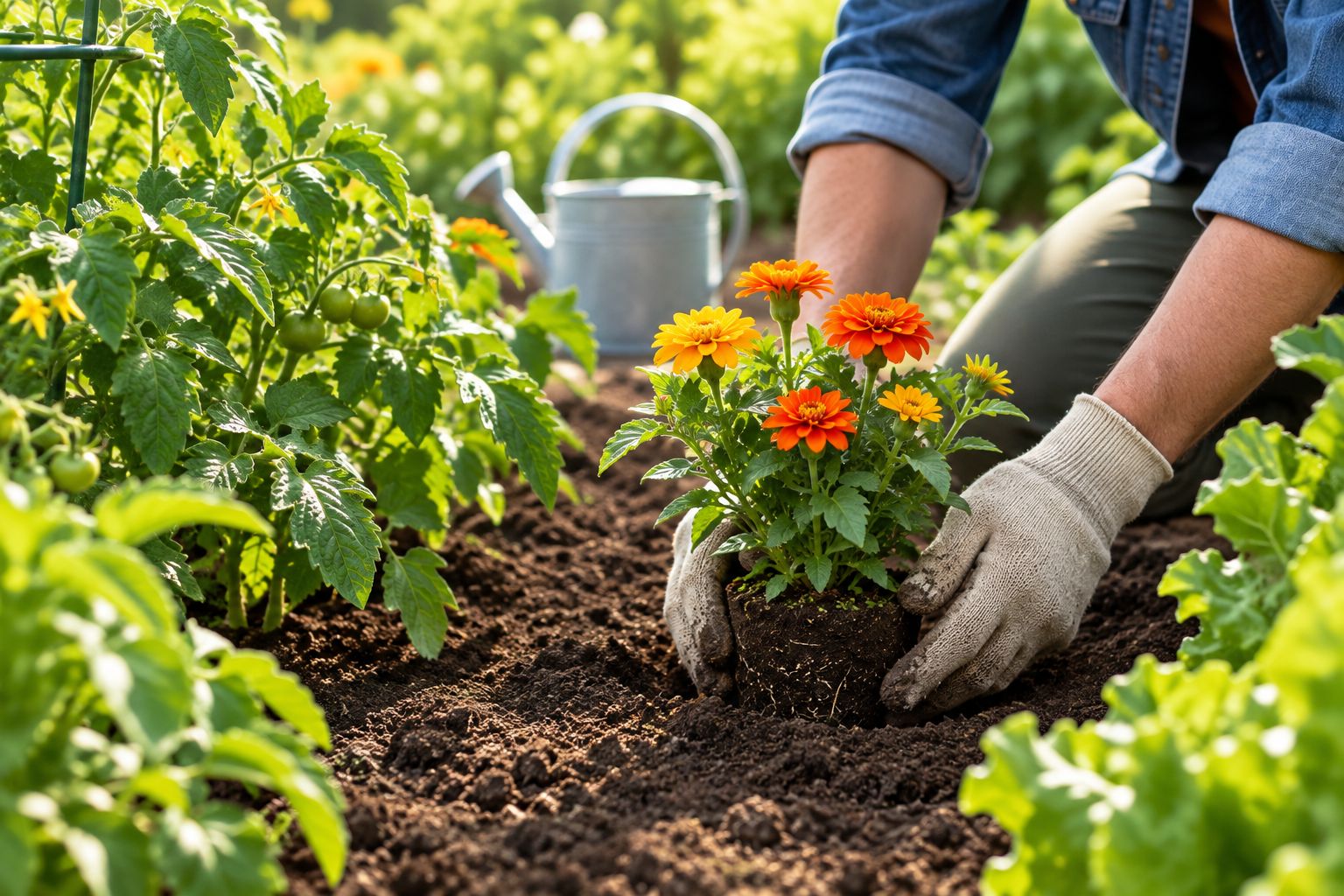
Moisten the root ball before planting, set it at its existing growing depth, and water the surrounding soil. Keep mulch away from the stem. Check moisture where the roots sit, not just at the dry-looking soil surface.
What marigolds can and cannot do for nematodes
A few marigolds beside tomatoes are not a reliable nematode treatment. University extension guidance describes suppression of certain plant-parasitic nematodes using selected marigolds grown as a planned cover crop. Results depend on both the marigold and the nematode involved.
That approach requires a dedicated planting area and sufficient growth before the susceptible crop, rather than scattered ornamentals among vegetables. Weeds can also maintain host plants for nematodes, so planting marigolds without managing the area misses part of the job.
If vegetables show persistent poor growth, identify the cause before buying a companion plant. Root damage, nutrient problems, drought, and drainage problems require different responses. Ask your Virginia Cooperative Extension office about appropriate diagnosis and sampling.
For 2026 planning, useful reference scopes are Clemson Cooperative Extension’s marigold growing guidance, UF/IFAS Extension’s marigold and nematode-management guidance, and Virginia Cooperative Extension’s local planting advice. None supports treating every marigold variety as protection against every garden pest.
Seeds or plugs: choose the starting stage
Seeds let you select a named variety from its packet and raise the seedlings yourself. That means providing suitable germination conditions, light, and care before the plants reach the garden.
Plugs begin as small rooted plants. They skip germination in your home, but they do not skip establishment, frost protection, or watering. Neither seeds nor plugs are equivalent to mature flowering plants.
Meadows Garden Company suits Virginia gardeners seeking flower plugs rather than starting every plant from seed. Confirm the botanical name, variety, and quantity before making a planting plan. Do not assume an unnamed marigold plug has Bonanza’s size, Disco’s flower form, or suitability for a specific nematode-management purpose.
How the choices rank
The ranking prioritizes fit in a home vegetable garden: mature size, flower access, ease of placement, and limitations. Bonanza takes the default position because a compact border is a useful arrangement when bed space is restricted.
Disco, Lemon Gem, and Crackerjack each serve a different purpose. This is not a ranking of measured pest-control performance, and the named choices are not presented as products in the Meadows Garden Company catalogue.
Which marigold should you choose?
Choose Bonanza for a compact border, Disco for open flowers, Lemon Gem for an herb-bed accent, and Crackerjack for a tall backdrop. Let the space decide before the flower color does.
For an undecided gardener, start with compact French marigolds outside the vegetable canopy. If your main goal is insect access to flowers, choose the single-flowered Disco type instead. If your main goal is treating a diagnosed nematode problem, stop comparing ornamental appearance and follow a species-specific extension recommendation.
FAQ
What's the best marigold variety for companion planting with tomatoes?
A compact French marigold such as Bonanza is a practical choice for a sunny tomato-bed edge. Keep it outside the tomato's mature canopy; it does not provide automatic pest protection.
Are French marigolds better than African marigolds beside vegetables?
French marigolds are the better fit for compact borders, while tall African marigolds suit a separate backdrop. Choose by mature size and placement rather than assuming one group protects vegetables better.
Which marigolds have open flowers for visiting insects?
Single-flowered French marigolds such as Disco have exposed flower centers. Choose that flower form over densely double blooms when access to the flower is your priority.
When should I plant marigolds outside in Virginia in 2026?
Plant marigolds outside after frost danger has passed at your location. Use local frost guidance and the forecast because Virginia's coastal and mountain gardens require different timing.
Do marigolds keep all bugs away from a vegetable garden?
No, marigolds do not keep all bugs away from vegetables. Identify the pest and use an appropriate management method instead of relying on a flowering border.
Can a few marigolds beside tomatoes get rid of nematodes?
A few border marigolds are not a reliable nematode treatment. Suppression guidance concerns selected marigolds grown as a planned cover crop for particular plant-parasitic nematodes.
Should I choose marigold seeds or flower plugs?
Choose seeds if you want to raise seedlings yourself, or plugs if you want to begin with young rooted plants. Both still require suitable planting conditions, establishment care, and protection from frost.
One last thing
Marigolds are not Virginia native plants. They can be useful seasonal flowers, but planting them does not replace a native planting designed around local habitat needs.
For your 2026 garden, keep those decisions separate: choose marigolds to fit the vegetable border, and choose suitable native plants for a longer-term habitat planting. That distinction gives each part of the garden a clear purpose.